1
Country: USA | Funding: $578.8M
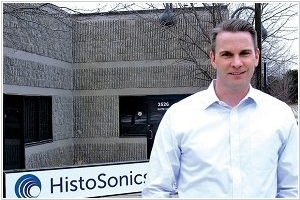
HistoSonics has developed Edison - noninvasive ultrasound therapy platform, which utilizes histotripsy to destroy target liver and kidney tumors at the subcellular level. This is a form of focused ultrasound utilizes high-amplitude, very short pulses to create a "bubble cloud" designed to mechanically disrupt and liquefy target liver tumors. These bubble clouds form and collapse in microseconds, generating mechanical forces strong enough to destroy tissue at the cellular and subcellular levels in a noninvasive and nonthermal manner. The Edison device provides continuous imaging, personalized treatment and physician guidance. Acquired by K5 Global
HistoSonics has developed Edison - noninvasive ultrasound therapy platform, which utilizes histotripsy to destroy target liver and kidney tumors at the subcellular level. This is a form of focused ultrasound utilizes high-amplitude, very short pulses to create a "bubble cloud" designed to mechanically disrupt and liquefy target liver tumors. These bubble clouds form and collapse in microseconds, generating mechanical forces strong enough to destroy tissue at the cellular and subcellular levels in a noninvasive and nonthermal manner. The Edison device provides continuous imaging, personalized treatment and physician guidance. Acquired by K5 Global
2

Country: Switzerland | Funding: $365.4M
ALENTIS Therapeutics develops novel therapeutics for the treatment of advanced liver fibrosis and liver cancer. The company is developing a portfolio of antibody-drug conjugates (ADCs) and monoclonal antibodies against its therapeutic target, claudin-1. Its unique antibodies specifically target exposed claudin-1 to open the rigid extracellular matrix, block disease signals and, in cancer, selectively kill tumor cells. ALENTIS's clinical candidates include the ADC ALE.P02 for the treatment of squamous cell carcinomas and the monoclonal antibody lixudebart for the treatment of organ fibrosis. In addition to clinical development, its preclinical programs include other anti-claudin-1 therapies, including other ADCs.
ALENTIS Therapeutics develops novel therapeutics for the treatment of advanced liver fibrosis and liver cancer. The company is developing a portfolio of antibody-drug conjugates (ADCs) and monoclonal antibodies against its therapeutic target, claudin-1. Its unique antibodies specifically target exposed claudin-1 to open the rigid extracellular matrix, block disease signals and, in cancer, selectively kill tumor cells. ALENTIS's clinical candidates include the ADC ALE.P02 for the treatment of squamous cell carcinomas and the monoclonal antibody lixudebart for the treatment of organ fibrosis. In addition to clinical development, its preclinical programs include other anti-claudin-1 therapies, including other ADCs.
3

Country: USA | Funding: $256M
Acepodia develops targeted cell therapies for cancer patients. The company has developed innovative immune cell activators with enhanced and targeted efficacy through antibody-cell conjugation (ACC) technology. As advertised they feature improved safety and broad applicability across hematological and solid tumors. The ACC technology is based on the 2022 Nobel Prize-winning bioorthogonal chemistry developed by Professor Carolyn Bertozzi. With ACC technology, tumor-targeting antibodies are conjugated to allogeneic immune cells, such as natural killer cells and gamma-delta-2 T cells. The second company's platform, Acepodia Antibody-Dual-Drugs Conjugation (AD2C), enables the facile integration of multiple linker payloads through a site-specific conjugation process. The company's flagship drug is in clinical trials for the treatment of liver cancer.
Acepodia develops targeted cell therapies for cancer patients. The company has developed innovative immune cell activators with enhanced and targeted efficacy through antibody-cell conjugation (ACC) technology. As advertised they feature improved safety and broad applicability across hematological and solid tumors. The ACC technology is based on the 2022 Nobel Prize-winning bioorthogonal chemistry developed by Professor Carolyn Bertozzi. With ACC technology, tumor-targeting antibodies are conjugated to allogeneic immune cells, such as natural killer cells and gamma-delta-2 T cells. The second company's platform, Acepodia Antibody-Dual-Drugs Conjugation (AD2C), enables the facile integration of multiple linker payloads through a site-specific conjugation process. The company's flagship drug is in clinical trials for the treatment of liver cancer.
4

Country: USA | Funding: $146.5M
CancerVax is developing a new bispecific antibody vaccine for the treatment of recurrent Ewing sarcoma. This therapeutic vaccine can target and attach to Ewing sarcoma cancer cells, recruiting the body's natural killer T cells to the tumor to destroy it; hence the name "bispecific." In extensive laboratory cell studies, several candidates demonstrated significant T-cell killing of Ewing sarcoma cells, meaning the vaccine was doing its job of recruiting T cells to the tumor cells for destruction. The company also has candidates for the treatment of pancreatic and liver cancer.
CancerVax is developing a new bispecific antibody vaccine for the treatment of recurrent Ewing sarcoma. This therapeutic vaccine can target and attach to Ewing sarcoma cancer cells, recruiting the body's natural killer T cells to the tumor to destroy it; hence the name "bispecific." In extensive laboratory cell studies, several candidates demonstrated significant T-cell killing of Ewing sarcoma cells, meaning the vaccine was doing its job of recruiting T cells to the tumor cells for destruction. The company also has candidates for the treatment of pancreatic and liver cancer.
5
Country: Israel | Funding: $33.1M
Starget Pharma is developing a somatostatin-based targeted cancer therapy platform. It combines therapeutic drugs with radioactive isotopes, minimizing damage to healthy tissue. One of the key advantages of this approach is the use of the same molecular platform for both diagnosis and treatment: first, the molecule is administered along with a diagnostic isotope to assess tumor uptake using imaging. If imaging confirms strong tumor uptake, the same molecule is combined with a more potent therapeutic isotope to deliver targeted therapy. The own AI platform enables faster discovery and development of highly accurate radiopharmaceuticals. The company is conducting clinical trials of this technology for the treatment of sarcoma, skin cancer, liver cancer and neuroendocrine tumors.
Starget Pharma is developing a somatostatin-based targeted cancer therapy platform. It combines therapeutic drugs with radioactive isotopes, minimizing damage to healthy tissue. One of the key advantages of this approach is the use of the same molecular platform for both diagnosis and treatment: first, the molecule is administered along with a diagnostic isotope to assess tumor uptake using imaging. If imaging confirms strong tumor uptake, the same molecule is combined with a more potent therapeutic isotope to deliver targeted therapy. The own AI platform enables faster discovery and development of highly accurate radiopharmaceuticals. The company is conducting clinical trials of this technology for the treatment of sarcoma, skin cancer, liver cancer and neuroendocrine tumors.
6

Country: Germany | Funding: $40K
TheraBionic manufactures FDA-cleared device TheraBionic P1 for the treatment of advanced hepatocellular carcinoma, with or without metastasis. It emits low-frequency radiofrequency electromagnetic fields that inhibit tumor cell growth without affecting normal cell growth. In clinical trials, TheraBionic's tumor-specific radiofrequency has been shown to be effective in shrinking tumors, blocking the growth of new cancer cells and increasing overall survival. The device is compact and easy to use. In multiple studies, patients treated with the device did not experience the debilitating side effects associated with other cancer treatments. The TheraBionic P1 is also being evaluated for the treatment of metastatic pancreatic cancer in combination with gemcitabine and nab-paclitaxel.
TheraBionic manufactures FDA-cleared device TheraBionic P1 for the treatment of advanced hepatocellular carcinoma, with or without metastasis. It emits low-frequency radiofrequency electromagnetic fields that inhibit tumor cell growth without affecting normal cell growth. In clinical trials, TheraBionic's tumor-specific radiofrequency has been shown to be effective in shrinking tumors, blocking the growth of new cancer cells and increasing overall survival. The device is compact and easy to use. In multiple studies, patients treated with the device did not experience the debilitating side effects associated with other cancer treatments. The TheraBionic P1 is also being evaluated for the treatment of metastatic pancreatic cancer in combination with gemcitabine and nab-paclitaxel.
7

Country: Italy | Funding: €1.8M
Soundsafe Care develops robotic device that utilizes ultrasound technology for the treatment of liver cancer. Its focused ultrasound provides a non-invasive and drug-free alternative to radiation therapy, reducing complications and hospitalization costs. Using advanced imaging and automation technologies, the device improves treatment precision and reduces intervention time. The company has developed proprietary software that automates the procedure, making it precise, reproducible and intuitive for the physician. Computer vision and robotics enable tracking and compensation of any potential movement of the therapeutic target, ensuring safety in various surgical settings and anatomical areas. Furthermore, therapy planning and automation speed up the treatment process.
Soundsafe Care develops robotic device that utilizes ultrasound technology for the treatment of liver cancer. Its focused ultrasound provides a non-invasive and drug-free alternative to radiation therapy, reducing complications and hospitalization costs. Using advanced imaging and automation technologies, the device improves treatment precision and reduces intervention time. The company has developed proprietary software that automates the procedure, making it precise, reproducible and intuitive for the physician. Computer vision and robotics enable tracking and compensation of any potential movement of the therapeutic target, ensuring safety in various surgical settings and anatomical areas. Furthermore, therapy planning and automation speed up the treatment process.
8

Country: Sweden | Funding: €71.4K
Double Bond Pharmaceutical has developed ways to treat these brain cancer, liver cancer and pneumonia much more effectively with its drug delivery system.
Double Bond Pharmaceutical has developed ways to treat these brain cancer, liver cancer and pneumonia much more effectively with its drug delivery system.